Lifting bags for force application — infinitely variable, jolt-free, up to 171.8 t.
Thanks to their low insertion height, our pneumatic lifting bags work flexibly, quickly and without jolting. Lift, push, press, pry or split the heaviest loads — safely and reliably, even on slopes and slippery ground.
What is a lifting bag?
A lifting bag – also called a lifting cushion, air cushion or pneumatic lifting set – is an inflatable cushion made of resistant rubber with a fabric insert that uses compressed air to lift, clamp, grip or push heavy loads. It is used above all by fire departments and rescue services for technical rescue operations, but equally in industry and construction.
The flat, robust cushion is pushed under the load and inflated via a compressor or a compressed-air cylinder. In doing so, it raises the load slowly and in a controlled way. As a complete set, we also offer the matching accessories: for example, the compressed-air supply of commercial vehicles can be used to operate the lifting bag. Our in-house manufactured control unit with a TUV-tested safety valve provides additional safety in use. We are also happy to offer technical advice and, if required, on-site user training.
How it works
- The flat cushion is pushed under the load (e. g. a vehicle, rubble or machine).
- It is inflated in a controlled way using a compressor or a compressed-air cylinder.
- As it inflates, it raises the load slowly and with precise control.
Advantages at a glance
- Flat design: fits under very low-clearance objects
- Powerful: can lift several tonnes
- Precise control: safe working in emergencies
- Non-slip profile: reliable on sand, grass & more
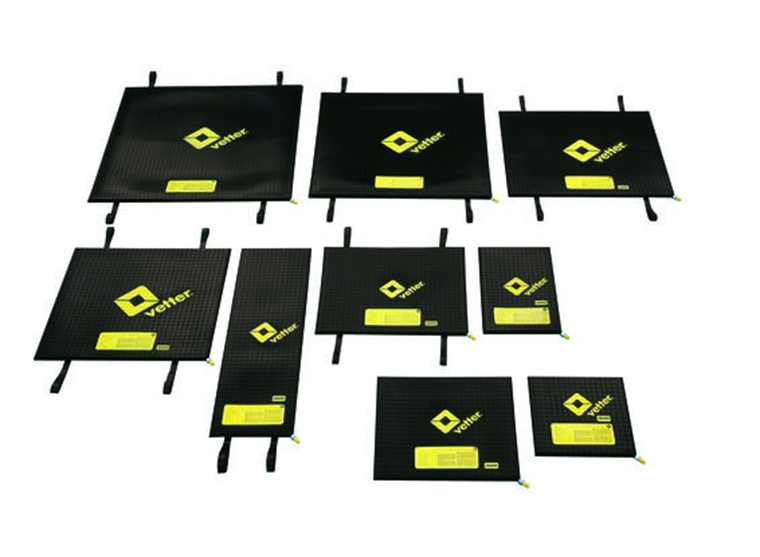
Six lifting bag series for every application
From the ultra-flat 1.6 cm mini version to the 171.8 t high-pressure system – all series are EN 13731 compliant and independently tested.
Mini lifting bags
Thanks to their low insertion height, our pneumatic mini lifting bags can be used in a variety of ways in industry and construction. The robust cushions impress with their optimal pressure-point distribution and, thanks to an optimised surface profile, cope easily with slippery ground such as sand or grass.
| Product | Size [cm] | Weight approx. [kg] | Operating pressure [bar] | Test pressure [bar] | Burst pressure [bar] | Lifting force max. [t] | Lift height max. [cm] | Air requirement [l] |
|---|---|---|---|---|---|---|---|---|
| V1 | 14 x 13 | 0.5 | 8 | 14 | 32 | 1 | 7.5 | 2.7 |
| V3 | 25.5 x 20 | 1 | 8 | 14 | 32 | 3.3 | 12 | 15.8 |
| V5 | 28 x 28 | 1.4 | 8 | 14 | 32 | 5.7 | 14.5 | 28.4 |
| V6 | 29.5 x 29.5 | 1.9 | 8 | 14 | 32 | 6.4 | 16.5 | 39.6 |
| V10 | 37 x 37 | 3.3 | 8 | 14 | 32 | 9.6 | 20.3 | 82.8 |
| V12 | 32 x 52 | 3.9 | 8 | 14 | 32 | 12 | 20 | 96.3 |
| V18 | 47 x 52 | 5.7 | 8 | 14 | 32 | 17.7 | 27 | 195.3 |
| V20 | 48 x 58 | 6.2 | 8 | 14 | 32 | 19.4 | 28 | 224.1 |
| V24 | 52 x 62 | 7.2 | 8 | 14 | 32 | 24 | 30.6 | 296.1 |
| V24 L | 31 x 102 | 6.8 | 8 | 14 | 32 | 24 | 20.1 | 211.5 |
| V31 | 65 x 69 | 10.1 | 8 | 14 | 32 | 31.4 | 37 | 517.5 |
| V35 L | 43 x 115 | 10 | 8 | 14 | 32 | 35.8 | 31 | 349.4 |
| V40 | 78 x 69 | 12.2 | 8 | 14 | 32 | 39.6 | 40.2 | 675 |
| V54 | 86 x 86 | 17.3 | 8 | 14 | 32 | 54.4 | 47.8 | 1117.8 |
| V68 | 95 x 95 | 20.7 | 8 | 14 | 32 | 67.7 | 52 | 1457.1 |
Sizes V1–V40 (8 bar) have an insertion height of 2.5 cm, V54–V68 of 2.8 cm.
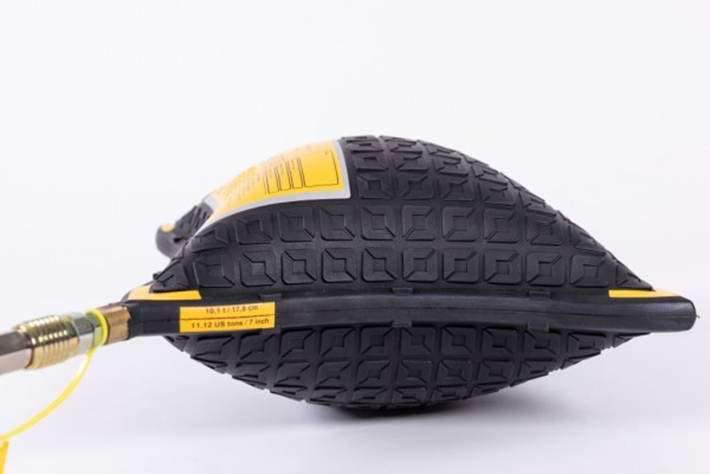
S.TEC high-pressure lifting bags
The next generation of high-pressure lifting bags: sensationally flat and uniquely powerful. With a dynamic 12 bar lifting force, it is one of the most impressive lifting bags on the market. With an insertion height of just 2.5 cm, it also fits into the narrowest gaps and openings. Thanks to an intelligent surface structure, 2 bags can be safely stacked, with maximum lifting force and lift height readable on the side.
| Product | Size [cm] | Weight approx. [kg] | Operating pressure [bar] | Test pressure [bar] | Burst pressure [bar] | Lifting force max. [t] | Lift height max. [cm] | Air requirement [l] |
|---|---|---|---|---|---|---|---|---|
| V1 | 14 x 13 | 0.5 | 12 | 18 | 48 | 1.3 | 7.4 | 4 |
| V5 | 25.5 x 20 | 1.3 | 12 | 18 | 48 | 4.6 | 12.1 | 23.2 |
| V7 | 28 x 28 | 2 | 12 | 18 | 48 | 7.5 | 15.8 | 54 |
| V10 | 32 x 32 | 2.6 | 12 | 18 | 48 | 10.1 | 17.8 | 120.3 |
| V12 | 35 x 35 | 3 | 12 | 18 | 48 | 12.3 | 19.5 | 191.3 |
| V20 | 44 x 44 | 4.8 | 12 | 18 | 48 | 20.2 | 24.5 | 253 |
| V26 | 47 x 52 | 6.2 | 12 | 18 | 48 | 25.9 | 27 | 279 |
| V33 L | 31 x 102 | 8 | 12 | 18 | 48 | 33.3 | 19.3 | 321.7 |
| V35 | 52 x 62 | 8.2 | 12 | 18 | 48 | 34.7 | 29.9 | 479 |
| V40 | 61 x 61 | 9.3 | 12 | 18 | 48 | 40.4 | 33.6 | 603 |
| V50 | 67.6 x 67.6 | 11.9 | 12 | 18 | 48 | 50.1 | 37.5 | 798.3 |
| V59 | 78 x 69 | 13.9 | 12 | 18 | 48 | 59.4 | 39.3 | 1103.7 |
| V83 | 86 x 86 | 19.1 | 12 | 18 | 48 | 82.7 | 46.6 | 1646 |
| V102 | 95 x 95 | 23.1 | 12 | 18 | 48 | 101.6 | 51.6 | 2301.3 |
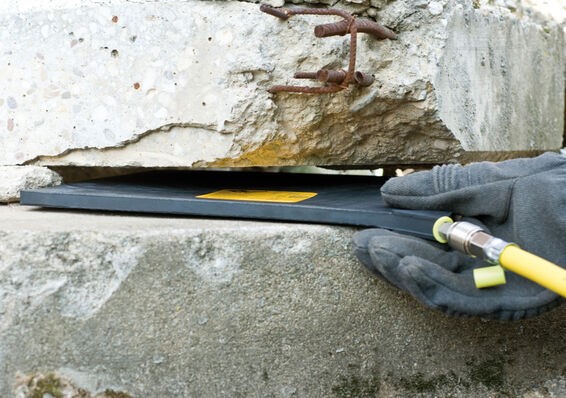
Ultra Flat cushions
With a super-flat insertion dimension of just 1.6 cm, Ultra Flat lifting bags are the ideal helper on site and fit into even the smallest gaps. They unleash their power in the tightest of spaces.
| Product | Size [cm] | Operating pressure [bar] | Burst pressure [bar] | Lifting force max. [t] | Lift height max. [cm] | Test pressure [bar] | Air requirement [l] | Weight approx. [kg] |
|---|---|---|---|---|---|---|---|---|
| UF 1 | 14 x 13 | 8 | 32 | 1 | 7.5 | 12 | 2.8 | 0.4 |
| UF 3 | 25.5 x 20 | 8 | 32 | 3.3 | 12 | 12 | 15.4 | 1 |
| UF 6 | 29.5 x 29.5 | 8 | 32 | 6.4 | 16.5 | 12 | 37.1 | 1.7 |
| UF 10 | 37 x 37 | 8 | 32 | 9.6 | 20.3 | 12 | 70.1 | 2.4 |
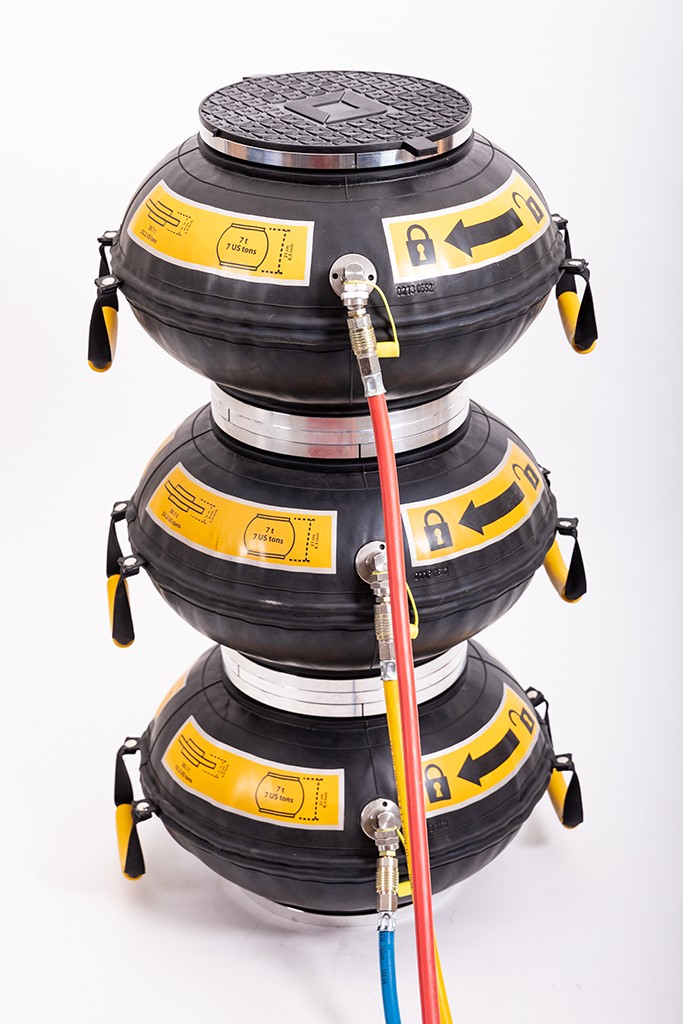
Connectable Bags C.TEC
The perfect solution for acting quickly in critical situations: Connectable Bags C.TEC12 combine the lifting force of the mini lifting bags with the lift height of the well-known 1 bar lifting bags. This lets you respond flexibly to different heights at any time. Thanks to tool-free connection technology, the bags are ready for use within seconds.
| Product | Operating pressure [bar] | Test pressure [bar] | Burst pressure [bar] | Initial lifting force, full surface contact* [t] | Initial lifting force, full contact load plate [t] | Final lifting force max. [t] | Lift height at final lifting force [cm] | Lift height max.* [cm] | Air volume at 12 bar [l] | Diameter [cm] | Weight [kg] | Insertion height [cm] |
|---|---|---|---|---|---|---|---|---|---|---|---|---|
| VCB 30 C.Tec12 | 12 | 18 | 48 | 30.1 | 14 | 7 | 21 | 29.3 | 420 | 56.5 | 18 | 9 |
| VCB 75 C.Tec12 | 12 | 18 | 48 | 74.7 | 41 | 12 | 35 | 45.9 | 1476 | 89 | 34 | 9 |
| VCB 172 C.Tec12 | 12 | 18 | 48 | 171.8 | 108 | 15 | 59 | 69 | 5048 | 135 | 58 | 11.5 |
*Initial lifting force and maximum lift height with full surface contact, without load plate, measured on the single bag.
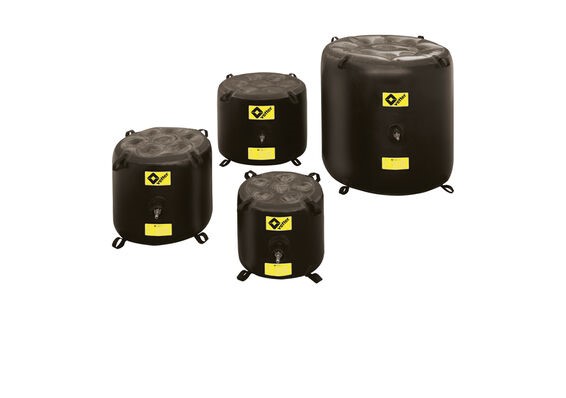
Cylindrical lifting bags
Rely on handcraft Made in Germany: internal stabilising bands prevent the pneumatic lifting bags from bulging and so create a level bearing surface over the entire lift path – with optimal pressure-point distribution. This allows even thin-walled bodies such as trucks, vans or light aircraft to be lifted without damage. Anti-slip indentations on the top and bottom provide firm grip on soft or slippery ground.
| Product | Operating pressure [bar] | Test pressure [bar] | Lifting force max. [t] | Diameter [cm] | Air requirement [l] | Weight approx. [kg] | Lift height max. [cm] |
|---|---|---|---|---|---|---|---|
| Single bag 1/6 | 1 | 1.5 | 3 | 61 | 328 | 7 | 56 |
| Single bag 1/9 | 1 | 1.5 | 4.5 | 76 | 667 | 9 | 76 |
| Single bag 1/13 | 1 | 1.5 | 6.5 | 91 | 1038 | 12 | 81 |
| Single bag 1/23 | 1 | 1.5 | 11.3 | 120 | 3023 | 21 | 127 |
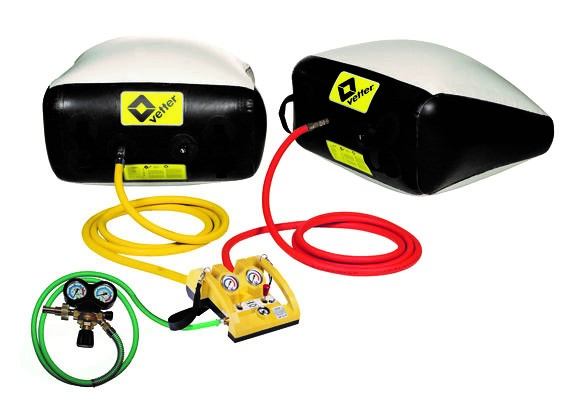
Wedge cushion
The special wedge shape provides an ideal lift angle: the load to be lifted is distributed evenly over the entire lift path. With their perfect pressure-point distribution, the pneumatic wedge cushions optimally lift thin-walled bodywork such as bus side panels while maintaining consistent, safe contact with both the bodywork and the ground.
| Product | Operating pressure [bar] | Test pressure [bar] | Lifting force max. [t] | Lift height max. [cm] | Size [cm] | Air requirement [l] | Weight approx. [kg] |
|---|---|---|---|---|---|---|---|
| Wedge cushion | 1 | 1.5 | 6 | 60 | 80 x 80 | 506 | 10.4 |
Correct placement & stacking
Placement under the load
- Load-bearing surface: level and firm, e. g. asphalt or concrete
- Centred under the centre of gravity: prevents tipping and slipping
- Full surface contact: no sharp edges between the bag and the load
- Use an interlayer: a rubber mat or wooden board distributes the load
- Enough clearance: also to the sides, so the bag can expand
Rules for stacking
- Maximum of 2 bags – exception: Connectable Bags C.Tec with up to 3 bags
- Same model: same manufacturer and type for an even load
- Larger bag on the bottom: for a more stable footing
- Inflate evenly: bottom bag first, then the top one
- Trained personnel only: e. g. fire departments or industrial specialists
Questions & answers about lifting bags
How does a lifting bag work?
A lifting bag is an inflatable cushion used to lift heavy loads – for example during technical rescue operations by fire departments or rescue services, but also in industry and construction. Lifting bags are usually made of resistant rubber or plastic with a fabric insert and are flat and flexible when not filled with air.
- Placement: The flat cushion is pushed under the load and, thanks to its low height, also fits into narrow gaps.
- Inflating with compressed air: Compressed air is fed into the bag via a hose, it inflates and slowly lifts the load.
- Lifting effect: The force is created by pressure (bar) combined with the area of the bag: force = pressure × area. The larger the bag and the higher the air pressure, the more weight can be lifted – sometimes several tonnes.
- Safety and control: Valves allow the pressure to be regulated precisely, so the load can be raised or lowered in a very controlled way.
How must a lifting bag be placed under a load?
A lifting bag must be placed carefully and strategically under a load so that lifting is safe and effective:
- Load-bearing surface: level, firm and load-bearing – e. g. asphalt, concrete or stabilised with support plates. Soft or uneven ground can cause the bag to slip sideways or sink in.
- As centred as possible under the centre of gravity: prevents one-sided lifting and reduces the risk of the load tipping or slipping.
- Full surface contact: the bag should have full-surface contact with the underside of the load, with no sharp edges or pointed objects in between.
- Use interlayers: a rubber mat or wooden board distributes the load evenly and protects the bag.
- Enough space to lift: also to the sides, so the bag can expand freely as it inflates.
- Never stack unsecured: two bags on top of each other only with special securing (“double lift”) and only if permitted by the manufacturer.
How many lifting bags may be stacked on top of each other?
As a rule, a maximum of two lifting bags may be used on top of each other – and only under certain conditions:
- Maximum of two bags: more is not permitted, as the construction would otherwise become unstable. Exception: the Connectable Bags C.Tec, where a maximum of three bags may be stacked.
- Same model or type: for an even load, the bags should be from the same manufacturer and type.
- Larger bag on the bottom: the larger bag always goes on the bottom, the smaller one on top, for a more stable footing.
- Interlayer recommended: a non-slip intermediate plate improves friction and prevents slipping.
- Watch the total lift height: two bags do not provide double the lift height, as they bulge outward under load.
- Inflate evenly: first the bottom, then the top bag – and the reverse when deflating.
- Trained personnel only: this technique should only be used by trained personnel, e. g. in fire departments or industry.
If you need specific information about a particular lifting bag, please feel free to contact us.
Further information
Which lifting bag fits your application?
Whether fire department, rescue service, industry or construction – we provide personal advice on the right series, offer on-site technical training and supply the complete accessories from a single source.
Get in touch now